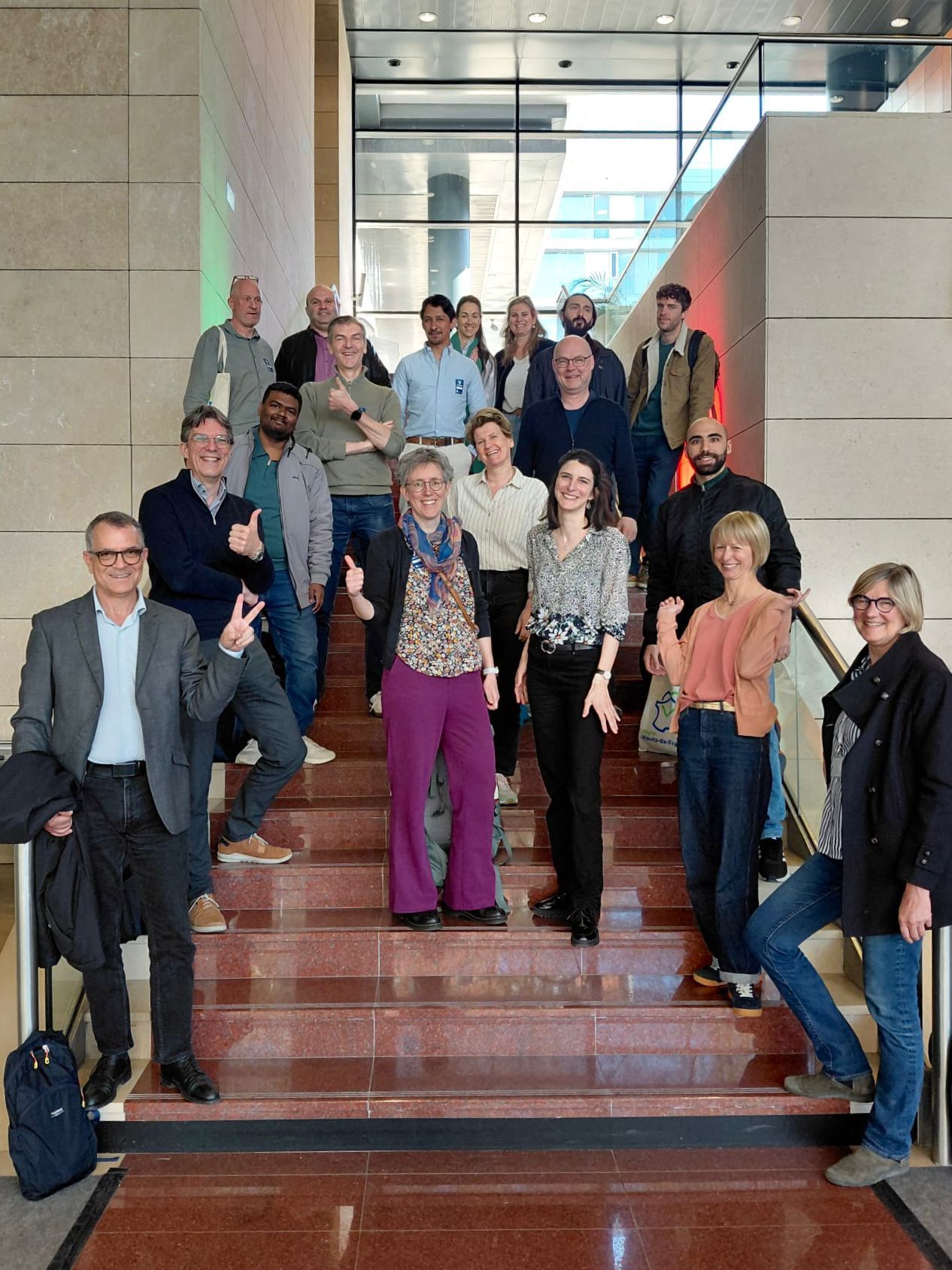
A myriad of partners are supporting the development of a local energy community in Fourmies (FR). Among them are the ACCU project partners including the French public electricity distribution network Enedis but also the Region Hauts-de-France who hosted the latest ACCU consortium partners meeting in Lens and Lille in April 2026.
ENEDIS: the public electricity distribution network
In France, the public distribution network Enedis is collaborating with the city of Fourmies in setting up a local energy system, by securing the grid connection for PV installations, providing data and dashboards of the local grid situation and analysing the flexibility potential for energy storage to contribute to the stability of the electricity system. „Enedis has produced a special report for the city: a map illustrating the local grid capacity. This tool enables the city to confidently expand its solar power generation capacity.”, explains Antoine Deleante, Responsible for energy and transport in the city of Fourmies.
At the ACCU meeting in April, Pascal Dassonville, Regional Director of ENEDIS Nord-pas-de-Calais region, was proud to present its team and their expertise: „These two days were an opportunity to share very concrete examples of this expertise, as close as possible to the field:
- the visit of our Regional Operations Centre, a real control tower of the network [for] the management, supervision and security of the electricity system,
- the presentation of a collective self-consumption experiment combining electric vehicle car-sharing and V2G teminals, carried out with [social housing provider] PARTENORD HABITAT, for the benefit of residents.
For us, the
participation in the ACCU project is a strong recognition of the know-how of
our teams, of the ability of the regions to be laboratories of innovation and
of the collective commitment to build the electricity system of tomorrow.“
Region Hauts-de-France
The Hauts-de-France Regional Authority, where the city of Fourmies is located, also supports the city in building its local energy community (LEC). In 2013, the region in partnership with the regional Chamber of Commerce and Industry launched the REV3 initative, also called “3rd industrial revolution”. Its objective is to achieve a low carbon and sustainable economy by 2050 via six areas of public policies: Renewable energy, Decarbonisation of industrial sectors, Energy efficiency of buildings, Sustainable mobility, Sustainable farming and Circular economy. The city joined the initiative and received support from the region. For example, in 2022 the region funded its initial LEC study and supported the town‘s first strategic projects for collective self-consumption of locally generated solar power. Fourmies, being the REV3 pilot town, regularly collaborates with the region on energy transition projects. Frédérique Parrad, project manager in the REV3 department of the region explained how the region supports REV3 partners 13 years after the launch of the initiative: “Today, the region provides funding for regional partners who promote REV3 and facilitate exchange of experience for local authorities. These support activities proved to be very useful.”
ACCU project partners
Local authorities, academic institutions, social housing providers and energy experts involved in ACCU are inventing together solutions to produce, store and share renewable energy within the three pilot territories in Fourmies, Bruges and Arnhem. In the past year they have researched best practices and developed tools related to technical, economic, organisational and regulatory issues to help the pilot LECs get off the ground. Here are some examples:
· Veolia supports the pilots in building strong buisness models for their LECs. The team has developed a financial calculation tool and a guidebook that will help LEC to assess their financial feasibility. The tool is based on the forecasted investment, operational and energy costs as well as revenues and other relevant parameters.
· OpenRemote has developed Energy Management System (EMS) procurement and implementation guide and EMS end user app for heat and storage. The goal of this system is to share energy in a smart way by optimizing energy flows within the LEC, maximising the self-consumption of local renewable energy, stabilising the grid and reducing the energy bills of participants.
· Université de Picardie Jules Verne (UPJV) assisted the city of Fourmies with the preparation of the tendering process and identified some technical solutions. The University has also collected good practices of Local Energy Communities in Europe and published them in a Good Practice Book that inspires not only the ACCU pilots but also other LEC initiatives and policy makers beyond the project.
· Energy Cities has drafted a guide that provides a clear overview of the legal steps that LEC founders must take and the issues they must solve at each step of the LEC implementation cycle, on their own or collectively with future participants.
All of these tools will be progressively available in the Results page of ACCU website.